

Did Colonial Have To Register Their Guns
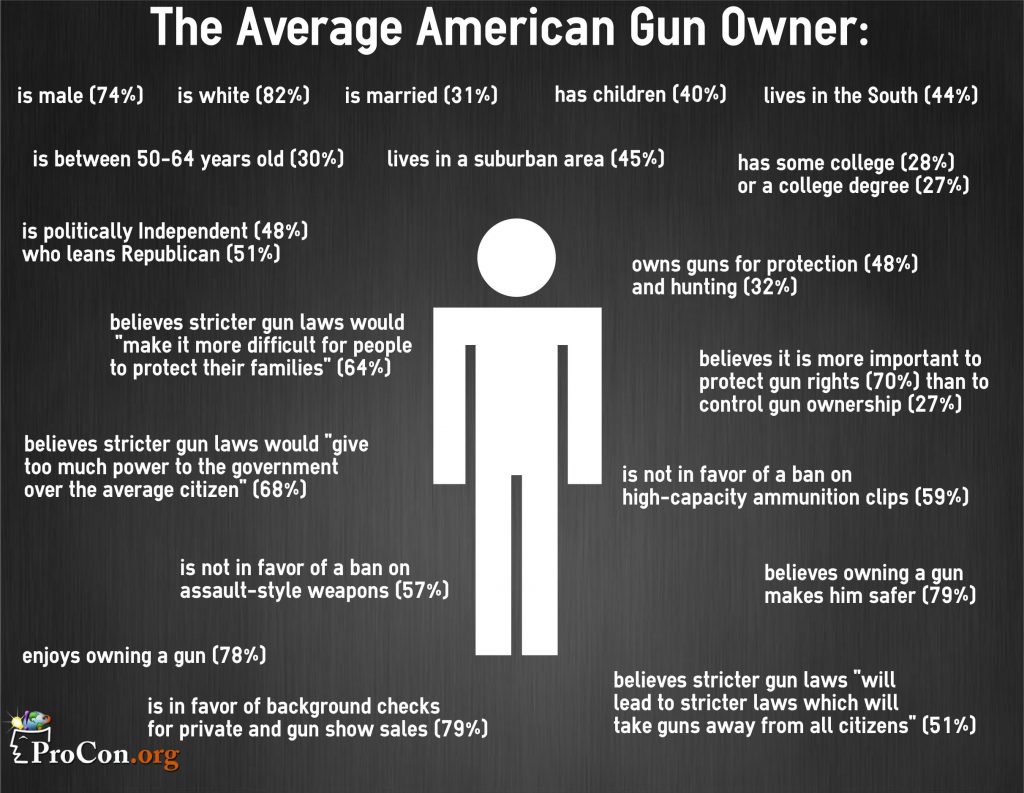
The United states of america has 120.5 guns per 100 people, or about 393,347,000 guns, which is the highest total and per capita number in the earth. 22% of Americans ain 1 or more than guns (35% of men and 12% of women). America's pervasive gun civilization stems in part from its colonial history, revolutionary roots, borderland expansion, and the Second Amendment, which states: "A well regulated militia, being necessary to the security of a gratis Country, the right of the people to keep and bear Artillery, shall not be infringed."
Proponents of more gun control laws state that the Second Amendment was intended for militias; that gun violence would be reduced; that gun restrictions take e'er existed; and that a majority of Americans, including gun owners, back up new gun restrictions.
Opponents say that the Second Amendment protects an individual's right to own guns; that guns are needed for self-defense from threats ranging from local criminals to strange invaders; and that gun buying deters crime rather than causes more criminal offense.
Guns in Colonial and Revolutionary America
Gun control laws are simply as old or older than the Second Amendment (ratified in 1791). Some examples of gun control throughout colonial America included criminalizing the transfer of guns to Catholics, slaves, indentured servants, and Native Americans; regulating the storage of gun powder in homes; banning loaded guns in Boston houses; and mandating participation in formal gathering of troops and door-to-door surveys nearly guns endemic. [1][ii]
Guns were mutual in the American Colonies, outset for hunting and general self-protection and subsequently as weapons in the American Revolutionary State of war. [105] Several colonies' gun laws required that heads of households (including women) own guns and that all able-bodied men enroll in the militia and carry personal firearms. [105]
Some laws, including in Connecticut (1643) and at least five other colonies, required "at least one developed human in every house to carry a gun to church or other public meetings" in order to protect against attacks by Native Americans; prevent theft of firearms from unattended homes; and, every bit a 1743 South Carolina law stated, safeguard against "insurrections and other wicked attempts of Negroes and other Slaves." [105] Other laws required immigrants to own guns in order to immigrate or own land. [105]
The Second Amendment of the U.s.a. Constitution was ratified on Dec. 15, 1791. The notes from the Ramble Convention do not mention an individual right to a gun for cocky-defence. [106] Some historians suggest that the idea of an individual versus a collective right would non have occurred to the Founding Fathers because the 2 were intertwined and inseparable: there was an individual right in order to fulfill the collective right of serving in the militia. [105][106]
Although guns were common in colonial and revolutionary America, so were gun restrictions. Laws included banning the auction of guns to Native Americans (though colonists oft traded guns with Native Americans for goods such as corn and fur); banning indentured servants (mainly the Irish) and slaves from owning guns; and exempting a multifariousness of professions from owning guns (including doctors, school masters, lawyers, and millers). [105]

Source: Saul Cornell, "What the 'Right to Conduct Arms' Really Means," www.salon.com, Jan. 15, 2011
A 1792 federal constabulary required that every man eligible for militia service ain a gun and armament suitable for military service, study for frequent inspection of their guns, and annals his gun ownership on public records. [101] Many Americans owned hunting rifles or pistols instead of proper war machine guns, and even though the penalty fines were loftier (over $9,000 in 2014 dollars), they were levied inconsistently and the public largely ignored the law. [105][106]
Country Gun Laws: Slave Codes and the "Wild West"
From the 1700s through the 1800s, so-chosen "slave codes" and, later on slavery was abolished in 1865, "black codes" (and, nonetheless later, "Jim Crow" laws) prohibited black people from owning guns and laws allowing the ownership of guns ofttimes specified "gratis white men." [98] For instance, an 1833 Georgia law stated, "it shall non exist lawful for any costless person of colour in this state, to own, utilize, or carry fire arms of whatever description any… that the free person of colour, and so detected in owning, using, or carrying fire artillery, shall receive upon his blank back, 30-ix lashes, and that the burn arm so found in the possession of said free person of color, shall be exposed for public auction." [107]
Despite images of the "Wild W" from movies, cities in the borderland often required visitors to check their guns with the sheriff before inbound the town. [108] In Oct. 1876, Deadwood, Dakota Territory passed a law stating that no 1 could burn down a gun without the mayor's consent. [109] A sign in Dodge City, Kansas in 1879 read, "The Carrying of Fire Artillery Strictly Prohibited." [108] The first law passed in Dodge Urban center was a gun control law that read "any person or persons found conveying concealed weapons in the city of Dodge or violating the laws of the Land shall be dealt with according to police force." [108]
Federal Gun Laws in the 1900s
The St. Valentine'due south Day Massacre on Feb. fourteen, 1929 in Chicago resulted in the deaths of seven gangsters associated with "Bugs" Moran (an enemy of Al Capone) and set off a serial of debates and laws to ban machine guns. [110][111] Originally enacted in 1934 in response to mafia crimes, the National Firearms Human activity (NFA) imposes a $200 tax and a registration requirement on the making and transfer of certain guns, including shotguns and rifles with barrels shorter than 18 inches ("short-barreled"), machine guns, firearm mufflers and silencers, and specific firearms labeled as "whatsoever other weapons" by the NFA. [112][113] Most guns are excluded from the Act.
The Federal Firearms Act of 1938 made it illegal to sell guns to certain people (including bedevilled felons) and required federal firearms licensees (FFLs; people who are licensed past the federal government to sell firearms) to maintain client records. [114] This Act was overturned by the 1968 Gun Command Act.
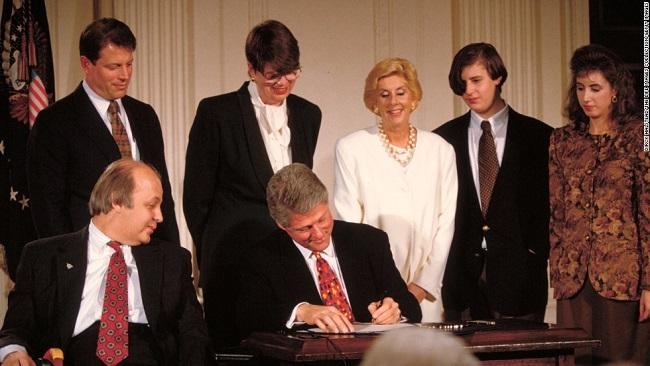
Source: Eric Bradner, "Hinckley Won't Face up New Charges in Reagan Press Secretarial assistant'southward Death," www.cnn.com, Jan 3, 2015
In 1968 the National Firearms Act was revised to address constitutionality concerns brought up by Haynes v. US (1968), namely that unregistered firearms already in possession of the owner practise non take to be registered, and data obtained from NFA applications and registrations cannot be used equally evidence in a criminal trial when the crime occurred before or during the filing of the paperwork. [112]
On Oct. 22, 1968, prompted by the assassinations of President John F. Kennedy (1963), Malcolm X (1965), Martin Luther King, Jr. (1968), and Robert F. Kennedy (1968), besides as the 1966 Academy of Texas mass shooting, President Lyndon B. Johnson signed the Gun Control Act of 1968 (GCA) into police. [115] The GCA regulates interstate gun commerce, prohibiting interstate transfer unless completed amid licensed manufacturers, importers, and dealers, and restricts gun ownership. [114]
The Firearm Owners' Protection Human activity of 1986 (FOPA) revised prior legislation in one case again. [112][113] The Human activity, amid other revisions to prior laws, immune gun dealers to sell guns away from the address listed on their license; limited the number of inspections the Bureau of Alcohol, Tobacco, and Firearms (at present the Bureau of Alcohol, Tobacco, Firearms and Explosives) could perform without a warrant; prevented the federal government from maintaining a database of gun dealer records; and removed the requirement that gun dealers continue runway of ammunition sales. [114]
The Brady Handgun Violence Prevention Act of 1993 (also chosen the Brady Act) was signed into law on November. xxx, 1993 and required a five-day waiting period for a licensed seller to hand over a gun to an unlicensed person in states without an alternate groundwork check organisation. [116] The five-day waiting period has since been replaced by an instant background check system that tin can take up to 3 days if there is an inconsistency or more information is needed to complete the auction. [114] Gun owners who have a federal firearms license or a state-issued permit are exempt from the waiting period. [114]
The Federal Assault Weapons Ban (Public Safety and Recreational Firearms Use Protection Act), part of the Violent Crime Control and Law Enforcement Deed of 1994, was signed into police by President Bill Clinton on Sep. 13, 1994. The ban outlawed 19 models of semi-automated assault weapons by proper noun and others by "military machine features," as well as large-capacity magazines manufactured after the law'southward enactment. [114] The ban expired on Sep. 13, 2004 and was not renewed due in part to NRA lobbying efforts. [114][117]
Federal and State Gun Laws in the 2000s
Protection of Lawful Commerce in Arms Act and Kid Prophylactic Lock Act of 2005 was enacted on Oct. 26 by President George W. Bush-league and gives broad civil liability immunity to firearms manufacturers so they cannot be sued past a gun death victim'southward family. [114][118] The Child Rubber Lock Deed requires that all handguns be sold with a "secure gun storage or condom device."[119]
The National Instant Criminal Background Check System (NICS) Improvement Amendments Act of 2007 was enacted as a condition of the Brady Act and provides incentives to states (including grants from the Chaser Full general) for them to provide information to NICS including information on people who are prohibited from purchasing firearms. [114] The NICS was implemented on November. 30, 1998 and afterwards amended on Jan. 8, 2008 in response to the Apr. xvi, 2007 Virginia Tech University shooting so that the Attorney Full general could more hands larn information pertinent to background checks such as disqualifying mental conditions. [120]
On Jan. 5, 2016, President Obama announced new executive actions on gun control. His measures take effect immediately and include: an update and expansion of groundwork checks (closing the "gun evidence loophole"); the addition of 200 ATF agents; increased mental health intendance funding; $4 1000000 and personnel to enhance the National Integrated Ballistics Data Network (used to link crimes in one jurisdiction to ballistics evidence in another); creating an Cyberspace Investigations Center to track illegal online gun trafficking; a new Section of Health and Human being Services dominion saying that it is not a HIPAA violation to report mental health information to the background cheque system; a new requirement to report gun thefts; new inquiry funding for gun safe technologies; and more funding to train law enforcement officers on preventing gun casualties in domestic violence cases. [142][143]

Source: TruthVoice, "Texas Set to Approve Open Behave of Pistols," www.truthvoice.com, Apr. 19, 2015
In addition to federal gun laws, each land has its ain set of gun laws ranging from California with the most restrictive gun laws in the country to Arizona with the most lenient, according to the Constabulary Center to Prevent Gun Violence and the Brady Campaign'due south "2013 Land Scorecard." [121]. 43 of fifty states take a "correct to carry arms" clause in their state constitutions. [101]
The most common state gun control laws include background checks, waiting periods, and registration requirements to purchase or sell guns. [121][122] Nigh states prevent carrying guns, including people with a concealed carry permit, on K-12 schoolhouse grounds and many states prevent conveying on college campuses. [121][122] Some states ban attack weapons. [121][122]
Gun rights laws include concealed and open carry permits, too as allowing gun carry in usually restricted areas (such as bars, G-12 schools, state parks, and parking areas). [121][122] Many states accept "shoot get-go" (also called "stand up your ground") laws. [121][122] Open carry of handguns is generally allowed in most states (though a permit may exist required). [121][122]
Collective v. Individual Right: Guns and the Supreme Court
Until 2008, the Supreme Court repeatedly upheld a collective right (that the right to ain guns is for the purpose of maintaining a militia) view of the Second Amendment, concluding that us may form militias and regulate guns. [47]
The first time the Court upheld an individual rights interpretation (that individuals have a Constitutional correct to own a gun regardless of militia service) of the Second Amendment was the June 26, 2008 United states of america Supreme Courtroom ruling in DC v. Heller. The Court stated that the right could be limited: "There seems to u.s.a. no uncertainty, on the basis of both text and history, that the Second Amendment conferred an individual right to proceed and bear arms. Of course the correct was not unlimited… Thus we do not read the Second Subpoena to protect the correct of citizens to acquit arms for any sort of confrontation, simply every bit we do not read the Commencement Amendment to protect the right of citizens to speak for whatever purpose." [1][3]
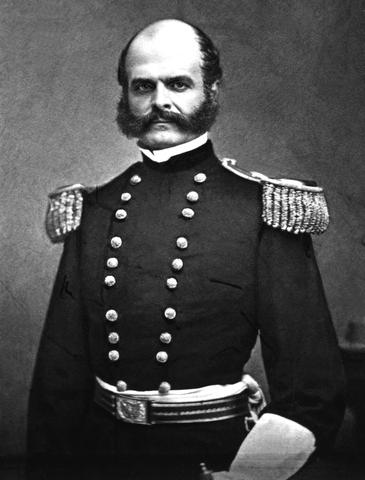
Source: John Hathorn, "General Ambrose E. Burnside, May 23-1924-September xiii, 1881," www.history.ncsu.edu (accessed May 11, 2015)
The US Supreme Court ruled on June 28, 2010 in McDonald v. Chicago that the Fourteenth Amendment, specifically the Due Process Clause, includes the Second Subpoena right to go along and bear artillery and, thus, the Second Amendment applies to the states equally well as the federal authorities, finer extending the individual rights interpretation of the 2nd Amendment to united states of america. [123]
On June 27, 2016, in Voisine 5. United States, the Supreme Courtroom ruled (6-2) that someone bedevilled of "recklessly" committing a violent domestic assault tin be disqualified from owning a gun under the 1996 Lautenberg Amendment to the 1968 Gun Control Act. Associate Justice Elena Kagan, JD, writing the bulk opinion, stated: "Congress enacted §922(1000)(ix) [the Lautenberg Subpoena] in 1996 to bar those domestic abusers convicted of garden-diverseness assault or battery misdemeanors–just similar those convicted of felonies–from owning guns." [150] [151] [152] [153]
On February. 20, 2018, the U.s. Supreme Courtroom indicated it would not hear an entreatment to California'south 10-day waiting period for gun buyers, thus leaving the waiting period in place. [156] Justice Clarence Thomas said the Court should accept heard the challenge, stating "The right to keep and bear arms is evidently this Court'due south ramble orphan," in reference to the Courtroom not hearing a major 2d Amendment case since 2010. [156]
On Apr. 27, 2020, the US Supreme Courtroom indicated it would non rule on New York State Rifle & Pistol Clan Inc. et al., v. City of New York. The case revolved around a New York City regulation that prevented residents with "premises licenses" to take their guns to second homes and shooting ranges exterior of New York Urban center. The city repealed the regulation when the U.s. Supreme Court agreed to hear the case. The ruling would take been the commencement on the scope of the Second Amendment in nigh a decade. [168]
On June xv, 2020, the Supreme Courtroom declined to hear almost a dozen cases highly-seasoned gun control laws, leaving the laws in place. In question were laws in Illinois, Maryland, Massachusetts, and New Jersey that require residents to see specific criteria to obtain a permit to carry exterior of their homes. Likewise in question was a Massachusetts police force banning certain semiautomatic guns and high-capacity magazines and a California law requiring microstamping technology and design features. Justices Thomas and Kavanaugh dissented, arguing that some of the cases should have been heard by the Supreme Courtroom. [173]
The National Rifle Clan (NRA)
The National Rifle Association calls itself "America's longest-standing civil rights organization." [124] Granted charter on November. 17, 1871 in New York, Civil War Matrimony veterans Colonel William C. Church and General George Wingate founded the NRA to "promote and encourage burglarize shooting on a scientific ground" to meliorate the marksmanship of Union troops. [125] General Ambrose Burnside, governor of Rhode Island (1866 to 1869) and Usa Senator (Mar. four, 1875 to Sep. 13, 1881), was the kickoff president. [125][126]
Over 100 years afterwards, in 1977, in what is known as the "Revolt at Cincinnati," new leadership inverse the bylaws to brand the protection of the Second Subpoena correct to behave artillery the master focus (ousting the focus on sportsmanship). [127][128] The grouping lobbied to disassemble the Gun Control Act of 1968 (the NRA alleged the Act gave power to the ATF that was abused), which they accomplished in 1986 with the Firearms Owners Protection Deed. [127]
In 1993 the Centers for Illness Control (CDC) funded a study completed past Arthur Kellerman and colleagues, published in the New England Journal of Medicine, titled "Gun Ownership every bit a Risk Factor in the Domicile," which establish that keeping a gun at domicile increased the risk of homicide. [129][130][131] The NRA defendant the CDC of "promoting the idea that gun buying was a affliction that needed to be eradicated," and argued that authorities funding should non be available to politically motivated studies. [129][130][131] The NRA notched a victory when Congress passed the Dickey Amendment, which deducted $2.half dozen billion from the CDC's budget, the exact corporeality of its gun research programme, and restricted CDC (and, later, NIH) gun research. [129][130][131] The amendment stated that "none of the funds fabricated available for injury prevention and control at the Centers for Illness Command and Prevention may be used to abet or promote gun command." [129][130][131] The admonition effectively stopped all federal gun research because, as Kellerman stated, "[p]recisely what was or was non permitted nether the clause was unclear. Only no federal employee was willing to risk his or her career or the agency's funding to notice out." [130] Jay Dickey (R-AR), at present retired from Congress, was the writer of the Dickey Amendment and has since stated that he no longer supports the amendment: "I wish nosotros had started the proper research and kept it going all this time… I take regrets." [144]
As of Jan. 2013, the NRA had approximately 3 1000000 members, though estimates take varied from 2.6 1000000 to 5 million members. [132] In 2013 the NRA spending upkeep was $290.half dozen million. [133] The NRA-ILA actively lobbies against universal checks and registration, "big" magazine and "assault weapons" bans, requiring smart gun features, ballistic fingerprinting, firearm traces, and prohibiting people on the terrorist watchlist from owning guns; and in favor of self-defense (stand your basis) laws. [134] In 2014 the NRA and NRA-ILA spent $3.36 million on lobbying activity aimed primarily at Congress but likewise the US Fish and Wild animals Service, National Park Service, Agency of Land Management, Army Corps of Engineers, and the Woods Service. [135]
On Aug. half-dozen, 2020, New York Chaser General Letitia James, JD, MPA, filed a lawsuit arguing for the dissolution of the NRA and the removal of CEO Wayne LaPierre. James has jurisdiction over the NRA because the organization has been registered equally a non-profit in New York for 148 years. The lawsuit argues that the NRA has displayed abuse, including ill-gotten funds, and misspending, including inflated salaries that diverted $64 meg from the NRA'south charitable mission to fund extravagant lifestyles. James likewise requested that LaPierre and iii tiptop executives repay NRA members. The lawsuit accuses LaPierre of arranging contracts for himself with the NRA worth $17 million without NRA board approval and of not reporting hundreds of thousands in income to the IRS. [177] [178]
Also on Aug. 6, 2020, DC District Attorney General Karl A. Racine, JD, filed a divide lawsuit against the NRA Foundation, alleging that it is not operating independently of the NRA as required by law, merely instead the NRA Foundation regularly loaned coin to the NRA to address deficits. [177] [178] The NRA stated it would countersue New York Chaser General James for "an unconstitutional, premeditated set on aiming to dismantle and destroy the NRA." [177] [178]
On January. xv, 2021, the NRA filed for bankruptcy, and appear plans to get out New York and move to Texas where the organisation will reincorporate. New York Attorney General Letitia James chosen the movement a "tactic to evade accountability and my part's oversight." NRA CEO and Executive Vice President Wayne Lapierre stated, "The NRA is pursuing reincorporating in a state that values the contributions of the NRA, celebrates our law-abiding members, and will bring together united states of america every bit a partner in upholding constitutional freedom." On May 11, 2021, a federal judge dismissed the defalcation filing, allowing legal proceedings against the NRA to proceed in New York. [180] [183]
The Gun Control Foyer
The beginning of the modernistic gun command move is largely attributed to Mark Borinsky, PhD, who founded the National Centre to Control Handguns (NCCH) in 1974. [136] Afterward existence the victim of an armed robbery, Borinsky looked for a gun control group to join but establish none, founded NCCH, and worked to grow the system with Edward O. Welles, a retired CIA officer, and Due north.T. "Pete" Shields, a Du Pont executive whose son was shot and killed in 1975. [136]

Source: Bijon Stanard, "Let'southward Talk: Obama Speaks; Dr. King's March on Washington 50th Anniversary!," letstalkbluntly.com, Aug. 8, 2013
In 2001, later on a few proper name changes, the National Center to Command Handguns (NCCH) was renamed the Brady Campaign to Prevent Gun Violence and its sister system, the Center to Prevent Handgun Violence, was renamed the Brady Center to Prevent Handgun Violence, though they are ofttimes referred to collectively as the Brady Campaign. [137] The groups were named for Jim Brady, a press secretarial assistant to President Ronald Reagan who was shot and permanently disabled on Mar. 30, 1981 during an bump-off attempt on the President. [137]
The 2014 gun control foyer was composed of Everytown for Gun Safety, Brady Campaign to Forbid Gun Violence, Coalition to Finish Gun Violence, Sandy Hook Promise, Americans for Responsible Solutions, and Violence Policy Middle. [138] Collectively, these groups spent $1.94 million in 2014, primarily aimed at Congress simply also the Executive Office of the President, the Vice President, the White Firm, Section of Justice, and the Agency of Booze, Tobacco, and Firearms. [138]
The most-recently bachelor full annual spending budgets for gun control groups were $13.seven 1000000 collectively (4.7% of the NRA's 2013 budget): including Everytown for Gun Safety ($iv.7 1000000 in 2012); the Brady Campaign ($2.7 one thousand thousand in 2012); the Brady Center ($iii.ane 1000000 in 2010); Coalition to Terminate Gun Violence ($308,761 in 2011); Sandy Hook Promise ($ii.2 million in 2013); and the Violence Policy Center ($750,311 in 2012). [133]
The Current Gun Control Debate
Largely, the current public gun command debate in the United States occurs after a major mass shooting. There were at least 126 mass shootings betwixt Jan. 2000 and July 2014. [139][140] Proponents of more gun command often want more laws to try to prevent the mass shootings and call for smart gun laws, background checks, and more protections against the mentally sick buying guns. Opponents of more gun laws accuse proponents of using a tragedy to farther a lost cause, stating that more laws would not have prevented the shootings. A December. 10, 2014 Pew Enquiry Middle survey found 52% of Americans believe the correct to own guns should exist protected while 46% believe gun buying should exist controlled, a switch from 1993 when 34% wanted gun rights protected and 57% wanted gun ownership controlled. [141] According to a Feb. twenty, 2018 Quinnipiac Poll taken before long afterward the February. 14 mass shooting at Marjory Stoneman Douglas Loftier School in Parkland, Florida, 66% of American voters support stricter gun command laws. [155]
On Dec. eighteen, 2018, the US Justice Department announced a new rule banning bump stocks, a gun attachment that allows a semi-automated gun to burn quickly like an automated weapon. Every bit of Mar. 26, 2019, the new rule classifies bump stocks every bit machine guns, which bans them nationwide under existing gun control laws. [161]
On April. 8, 2021, Chaser General Merrick Garland outlined five deportment to be taken past the Biden Assistants to adjourn gun violence:
A May 2019 Quinnipiac poll found that, while 61% of Americans are in favor of stricter gun laws, at that place were differences in support between political parties: 91% of Democrats, 59% of Independents, and 32% of Republicans supported more gun laws. [165]
- "Measure the problem of criminal gun trafficking in a data-driven fashion
- Close a regulatory loophole that has contributed to the proliferation of so-called 'ghost guns'
- Make clear that statutory restrictions on short-barreled rifles apply when certain stabilizing braces are added to loftier-powered pistols
- Publish model 'cherry flag' legislation for states
- Empower communities to combat and prevent gun violence, making more $i billion in funding available through over a dozen grant programs." [182]
On Aug. 4, 2021, the Mexican government sued U.s.a. gun manufacturers in Usa federal courtroom. The Mexican regime accused the manufacturers, including Smith & Wesson Brands, Inc.; Barrett Firearms Manufacturing, Inc.; Beretta UsA. Corp.; Colt's Manufacturing Visitor LLC, and Glock Inc, of "actively facilitating the unlawful trafficking of their guns to drug cartels and other criminals in Mexico." The Foreign Affairs Ministry estimates 70% of guns trafficked in Mexico came from the United states, contributing to 17,000 homicides in 2019 solitary. In February. 2022, the attorneys general of 13 states filed a brief in federal courtroom supporting the Mexican government'southward lawsuit. [184] [185]
2020 COVID-19 Pandemic
The 2020 COVID-19 (coronavirus) pandemic caused gun sales to rising, and resulted in a conflict between the NRA and several states when gun and ammo shops were not included as essential businesses during stay-at-home orders. [166] A significant portion of schools in the United states of america were temporarily closed in Mar. 2020 to forbid the spread of COVID-19 (coronavirus). That month was the first March to laissez passer without a school shooting since 2002, the twelvemonth most 2020 high school seniors were born. [167]
The FBI conducted over 3.7 million gun background checks in Mar. 2020 for the sale of one.9 million guns in the United states, the second highest number of gun sales in one month afterward Jan. 2013, which saw gun sales reach 2 1000000 following President Obama's reelection and the Dec. 14, 2012 Sandy Hook Elementary School shooting. The FBI conducted over 2.nine million groundwork checks in Apr. 2020, over iii.ane million in May 2020, over 3.9 million in June 2020 (an all-fourth dimension loftier), and over 3.half-dozen million in July 2020 as the COVID-19 (coronavirus) pandemic continued. [169][170][174][175]
The FBI conducted more background checks in 2020 than in whatever other yr since 1998 when the bureau began collecting data. The FBI reported 39,695,315 background checks completed in 2020, upwards from 2019 in which 28,369,750 million checks were performed. [181]

Source: https://gun-control.procon.org/history-of-gun-control/
Posted by: rodethermagreast.blogspot.com
0 Response to "Did Colonial Have To Register Their Guns"
Post a Comment