

How Many People Are Registered Independent
Independents oft are portrayed every bit political free agents with the potential to alleviate the nation's rigid partisan divisions. Nevertheless the reality is that most independents are not all that "independent" politically. And the pocket-sized share of Americans who are truly independent – less than x% of the public has no partisan leaning – stand out for their depression level of involvement in politics.
Among the public overall, 38% describe themselves as independents, while 31% are Democrats and 26% call themselves Republicans, co-ordinate to Pew Research Middle surveys conducted in 2018. These shares take inverse only modestly in recent years, merely the proportion of independents is higher than information technology was from 2000-2008, when no more than nigh a third of the public identified as independents. (For more on partisan identification over time, see the 2018 study "Broad Gender Gap, Growing Educational Divide in Voters' Political party Identification.")
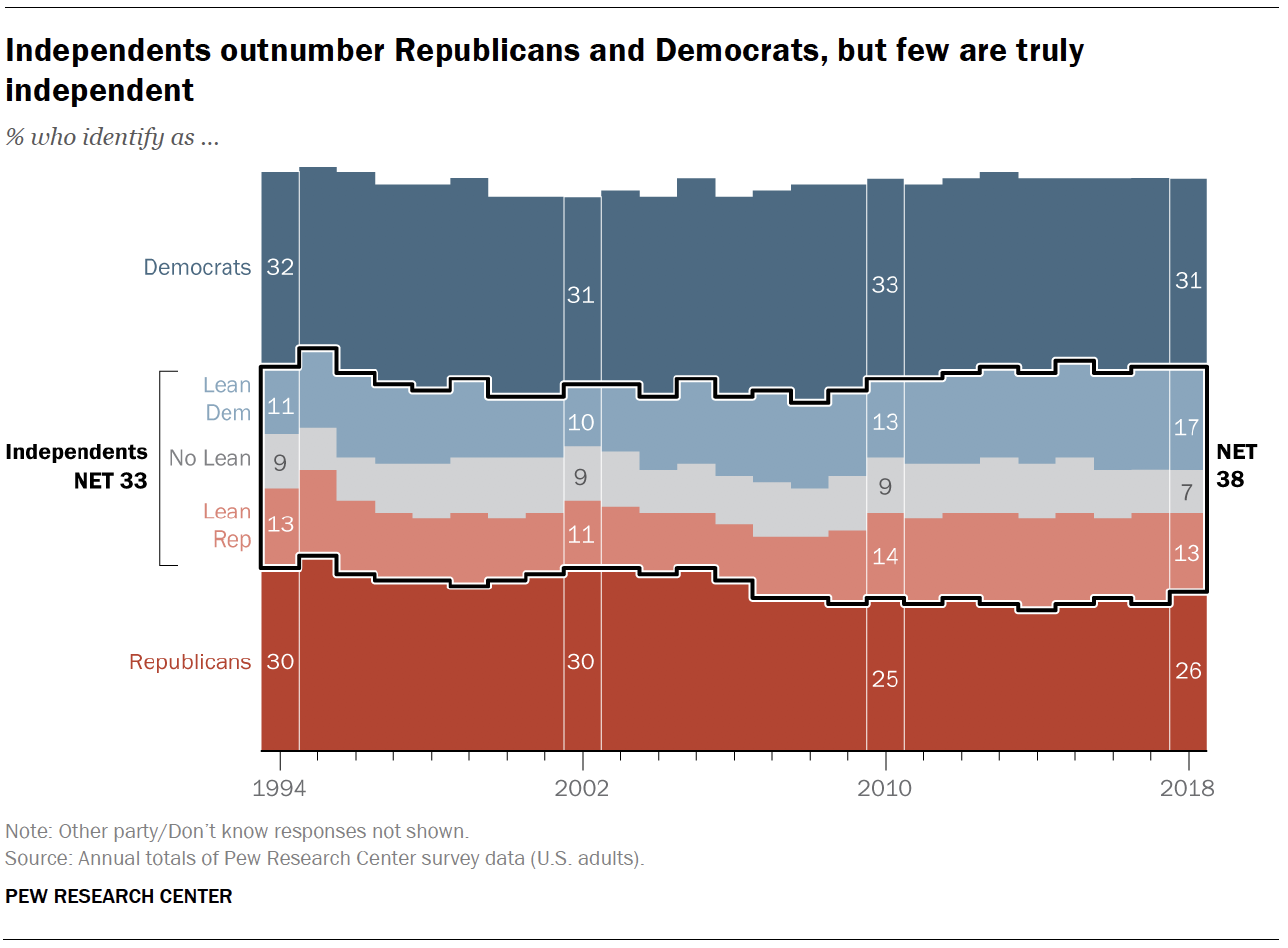
An overwhelming bulk of independents (81%) proceed to "lean" toward either the Republican Party or the Democratic Political party. Amid the public overall, 17% are Autonomous-leaning independents, while 13% lean toward the Republican Party. Just 7% of Americans decline to lean toward a political party, a share that has changed trivial in recent years. This is a long-continuing dynamic that has been the subject of past analyses, both by Pew Enquiry Centre and others.
In their political attitudes and views of most issues, independents who lean toward a political party are in full general agreement with those who affiliate with the same political party. For example, Republican-leaning independents are less supportive of Donald Trump than are Republican identifiers. Still, about lxx% of GOP leaners approved of his chore performance during his first two years in office. Democratic leaners, similar Democrats, overwhelmingly disapprove of the president.
 In that location are some bug on which partisan leaners – especially those who lean toward the GOP – differ substantially from partisans. While a narrow majority of Republicans (54%) opposed same-sexual practice-marriage in 2017, about vi-in-ten Republican-leaning independents (58%) favored allowing gays and lesbians to marry legally.
Yet independents who lean toward ane of the two parties have a strong partisan imprint. Majorities of Republican and Democratic leaners have a favorable opinion of their own political party, and they are almost as likely equally Republican and Autonomous identifiers to have an unfavorable stance of the opposing party.
Independents stand up out from partisans in several of import means. They are less politically engaged than Republicans or Democrats – and this is especially the case among independents who do not lean to a party.
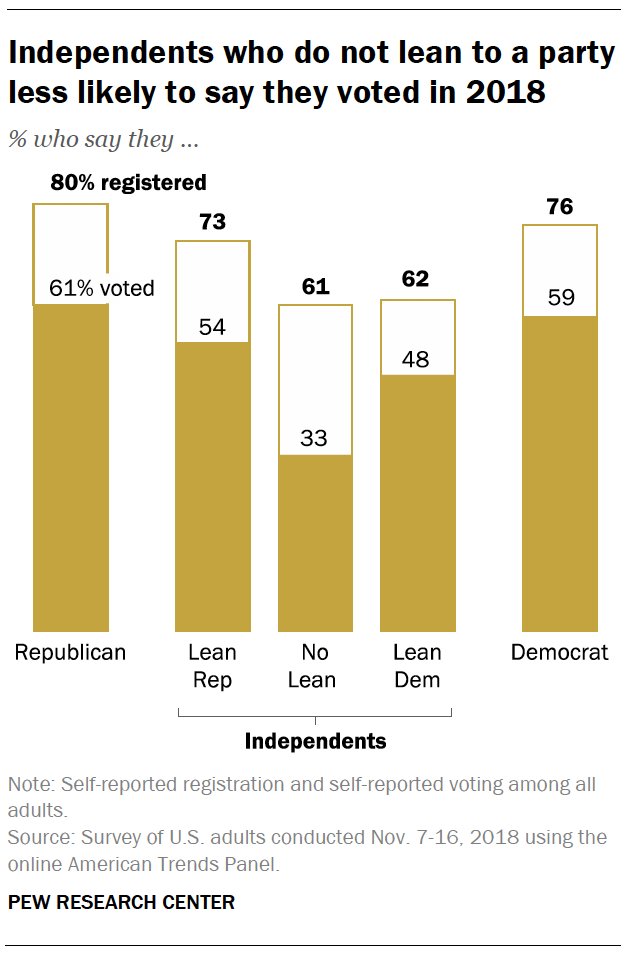
In a survey conducted last fall, presently after the midterm elections, partisan leaners were less likely than partisans to say they registered to vote and voted in the congressional elections. Virtually half of Democratic-leaning independents (48%) said they voted, compared with 59% of Democrats. The differences were comparable between GOP leaners (54% said they voted) and Republicans (61%).
Those who practice not lean toward a party – a group that consistently expresses less interest in politics than partisan leaners – were less probable to say they had registered to vote and much less likely to say they voted. In fact, simply a third said they voted in the midterms.
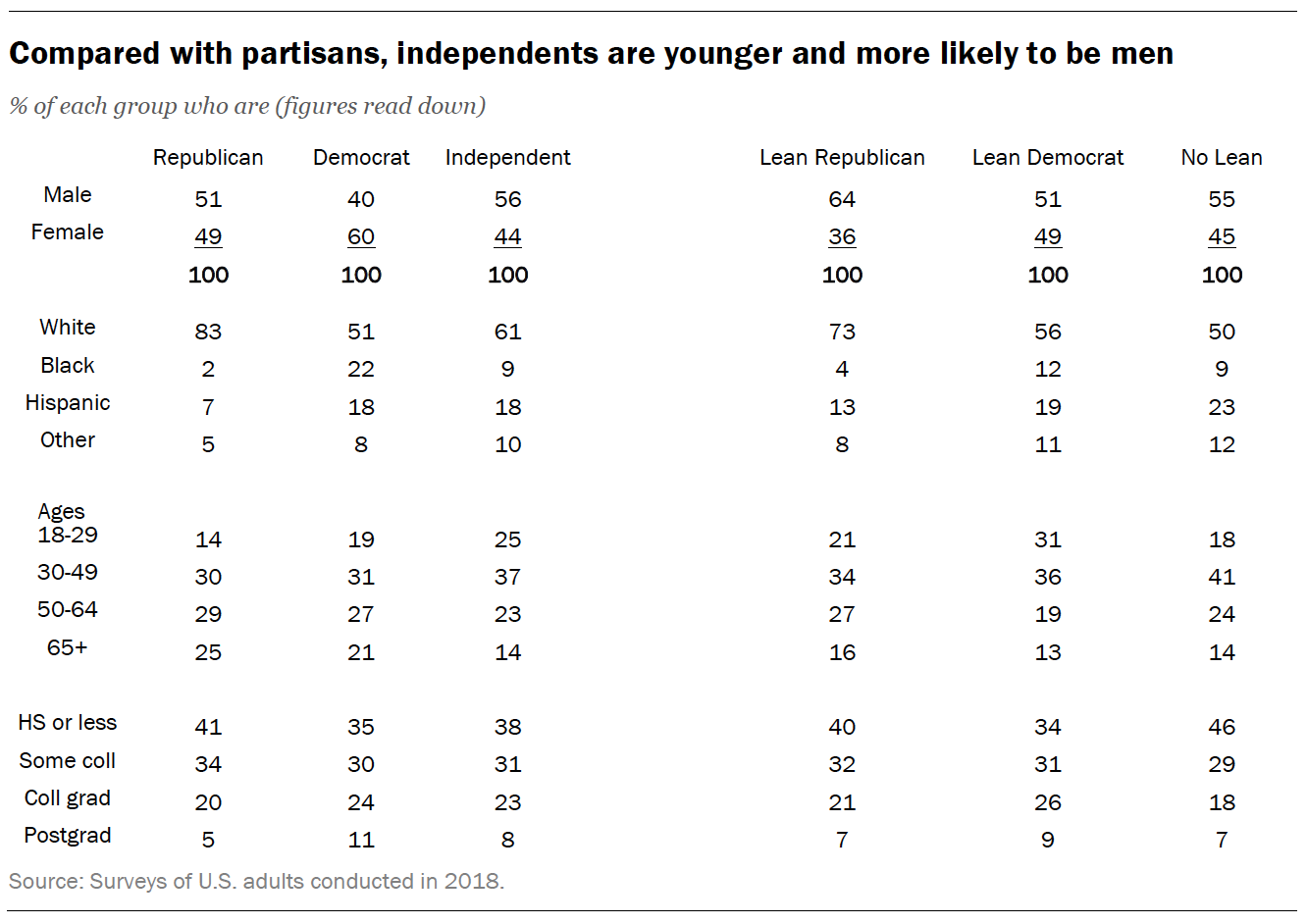
In addition, independents differ demographically from partisans. Men constitute a majority (56%) of independents. That is higher than the share of men amongst Republican identifiers (51% are men) and much higher than the share of men among Democrats (only 40%).
Among independents, men make upwards a sizable share (64%) of Republican leaners and a smaller majority (55%) of independents who exercise not lean. Autonomous leaners include roughly equal shares of men (51%) and women (49%).
Independents likewise are younger on average than are partisans. Fewer than half of independents (37%) are ages fifty and older; among those who identify as Democrats, 48% are 50 and older, as are a majority (54%) of those who identify as Republicans.
Democratic-leaning independents are younger than other independents or partisans. About a third (31%) are younger than 30, compared with 21% of Republican-leaning independents and just 19% and 14%, respectively, amongst those who place as Democrats and Republicans.
Trump divides partisans and partisan leaners akin
As Pew Research Center reported concluding year, Donald Trump'southward job blessing rating during the early phase of his presidency is more polarized along partisan lines than whatsoever president in the by six decades. In improver, Trump's rating has been more stable than prior presidents.
During his first ii years in office, Trump's job rating amid members of his own party was relatively high compared with recent presidents. In 2017, 85% of those who identify as Republicans approved of Trump'southward job performance, based on an average of Pew Research Center surveys. His job rating among Republicans was almost as loftier (84%) in 2018. Trump's early task rating amid members of the opposing political party (7%) was much lower than those of three prior presidents (Barack Obama, George W. Bush-league and Bill Clinton).
Trump's job rating among independents for his first ii years in office also was lower than his recent predecessors; his average job rating among independents was 34% in both 2017 and 2018. Obama's average rating was 50% during his first year (2009); information technology savage to 42% in his 2d year.
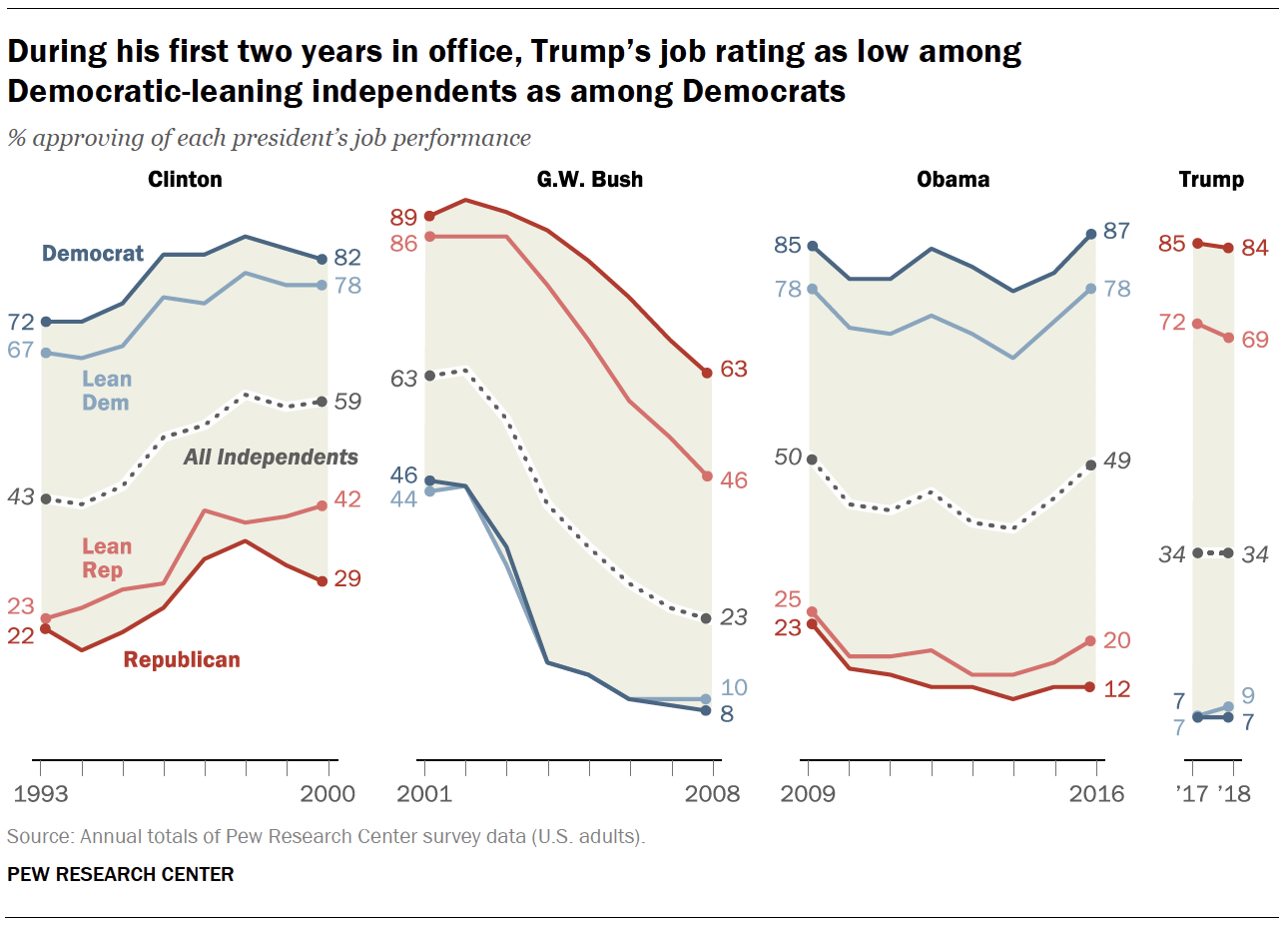
Trump's early on rating amid independents is closest to Clinton's, whose chore approving averaged about 42% during his beginning two years in part. Bush-league, whose overall job rating approached 90% in his first twelvemonth following the 9/11 terrorist attacks, had approving ratings above lx% among independents in his first two years.
Trump's chore rating amongst independents, like his overall rating, breaks down along partisan lines. His rating among GOP-leaning independents (72% in 2017, 69% in 2018) was not markedly different from Obama'southward and Clinton's ratings amongst Democratic-leaning independents during their first two years in office (though much lower than Bush's amongst Republican leaners).
Nevertheless Trump's rating amid independents who lean to the opposing party – similar his rating among members of the opposing party – was much lower than contempo presidents'. In fact, his rating amidst Democratic-leaning independents during his showtime two years was about equally low as his rating amid Democrats (seven% in 2017, nine% in 2018).
Trump's rating too was low amid independents who have no partisan leanings. Simply well-nigh a quarter of non-leaners approved of Trump'due south job performance during his first ii years, while most 6-in-10 (58%) disapproved.
Independents' views of U.S.-Mexico border wall, other fundamental bug
On most problems, independents' attitudes mirror the views of the overall public. Independents who lean toward a party are unremarkably on the same side every bit those who identify with the aforementioned party, just the level of agreement between leaners and partisans varies depending on the issue.
Past a broad margin (62% to 36%), independents oppose Trump's signature policy proposal, an expansion of the U.S.-Mexico border wall. Democratic-leaning independents overwhelmingly oppose the edge wall (95% disapprove), as practice Democratic identifiers (92%).
Republican-leaning independents favor expanding the border wall, though by a smaller margin than Republicans identifiers. GOP leaners favor substantially expanding the wall along the U.S.-Mexico border by roughly three-to-i (75% to 23%). Among those who affiliate with the Republican Party, the margin is nearly eight-to-one (87% to 11%).
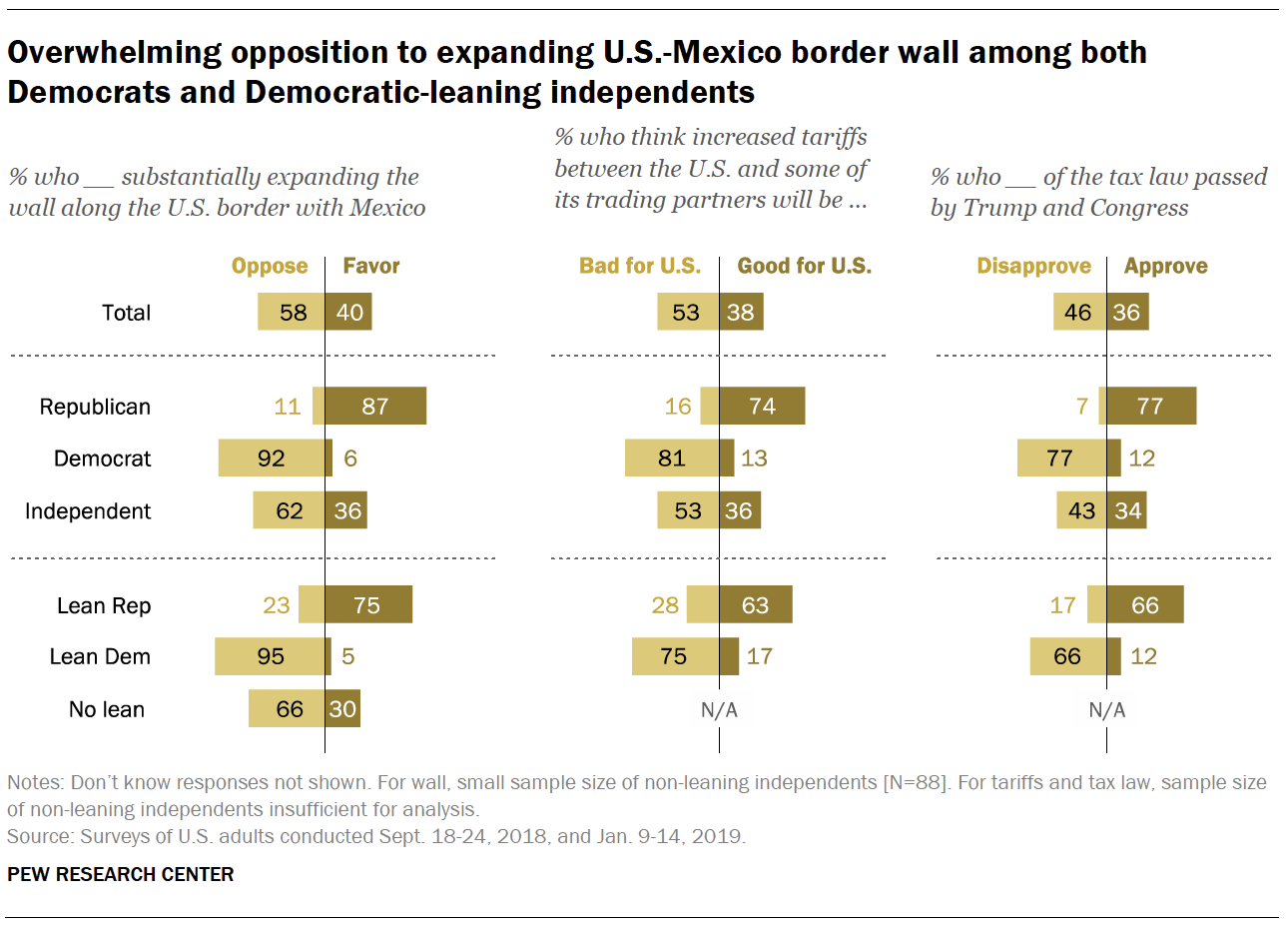
Independents too have a negative view of increased tariffs between the U.S. and its trading partners (53% say they will exist bad for the U.S., 36% good for the U.Southward.). Independents' views on the 2017 taxation bill are more divided: 34% approve of the tax law and 43% disapprove.
As with the border wall, Autonomous-leaning independents are more probable to view increased tariffs negatively (75% say they will be bad for the U.Southward.) than Republican-leaning independents are to view them positively (66% say they will exist expert). On taxes, two-thirds of GOP leaners approve of the tax law, while an identical share of Autonomous leaners disapprove.
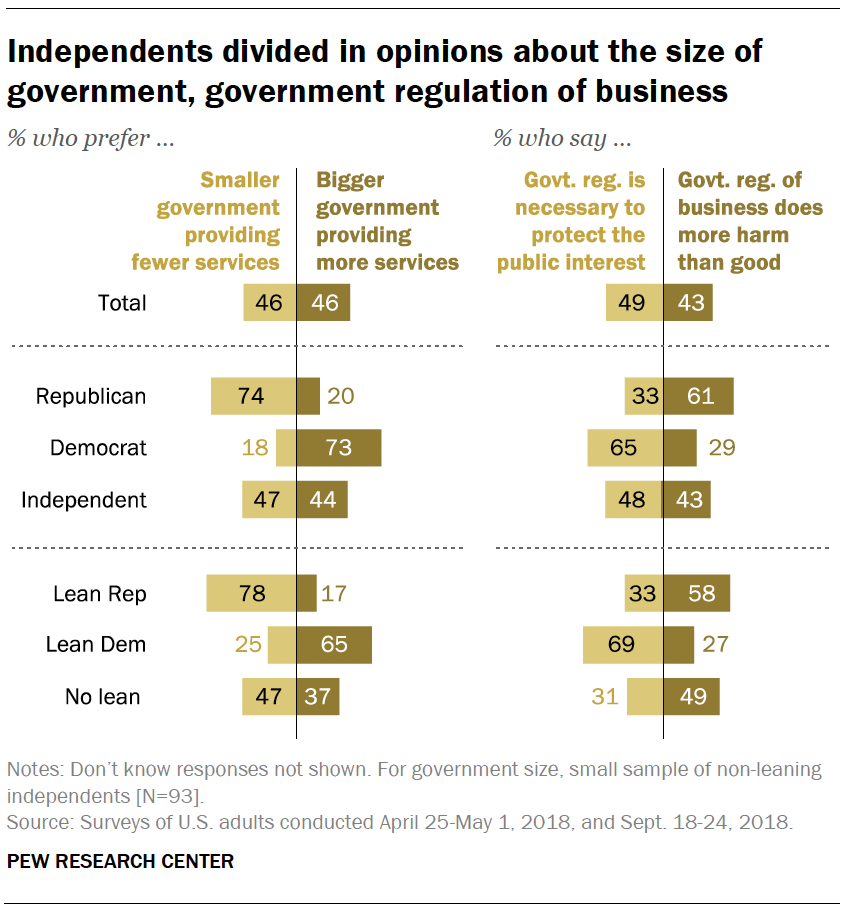 Overall, independents are divided in preferences about the size of government and views about government regulation of business.
Republican-leaning independents largely prefer a smaller government providing fewer services; 78% favor smaller government, compared with simply 17% who favor bigger authorities with more services.
The views of GOP leaners are nearly identical to the opinions of those who chapter with the GOP (74% adopt smaller government). Like Democrats, most Democratic-leaning independents prefer bigger government.
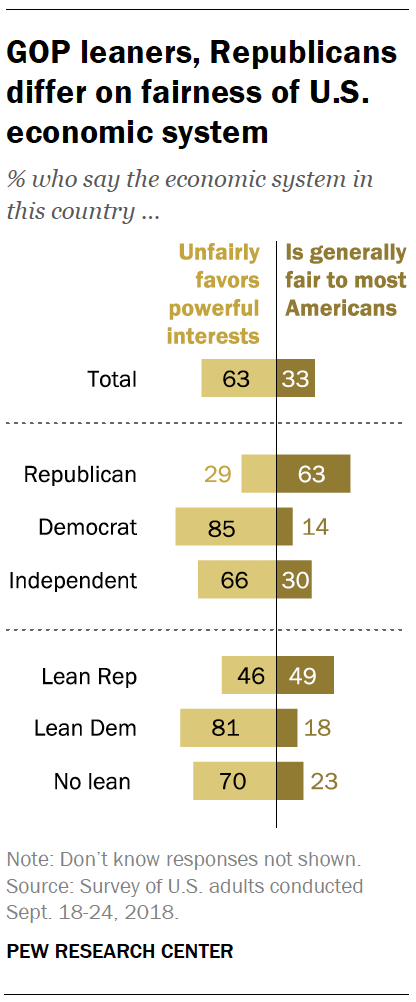 Democrats and Democratic leaners are in sync in opinions about whether the nation's economic organisation is generally off-white. Just there are sharper differences in the views of Republicans and GOP leaners.
A 63% bulk of those who place as Republicans say the U.Southward. economic organisation is off-white to about Americans; fewer than half as many (29%) say the system unfairly favors powerful interests. GOP leaners are divided: 49% say the system is generally fair, while nearly as many (46%) say information technology unfairly favors powerful interests.
Large majorities of both Democrats (85%) and Democratic leaners (81%) say the U.S. economic system unfairly favors powerful interests. Most independents who do not lean toward a party share this view (70%).
Independents' views of race, immigrants, gender
Majorities of independents say the U.S. needs to continue to make changes to give blacks equal rights with whites (57%) and that significant obstacles still make it harder for women to go ahead (54%). In add-on, far more independents say immigrants do more than to strengthen (66%) than brunt (23%) the country.
In views of racial equality and women's progress, the views of partisan leaners are comparable to those of partisans. Large majorities of Democrats and Autonomous leaners say the U.Due south. needs to make more changes to give blacks equal rights and that significant obstacles stand in the way of women. Virtually Republicans and Republican leaners say the country has made needed changes to requite blacks equal rights with whites, and that the obstacles blocking women'south progress are largely gone.
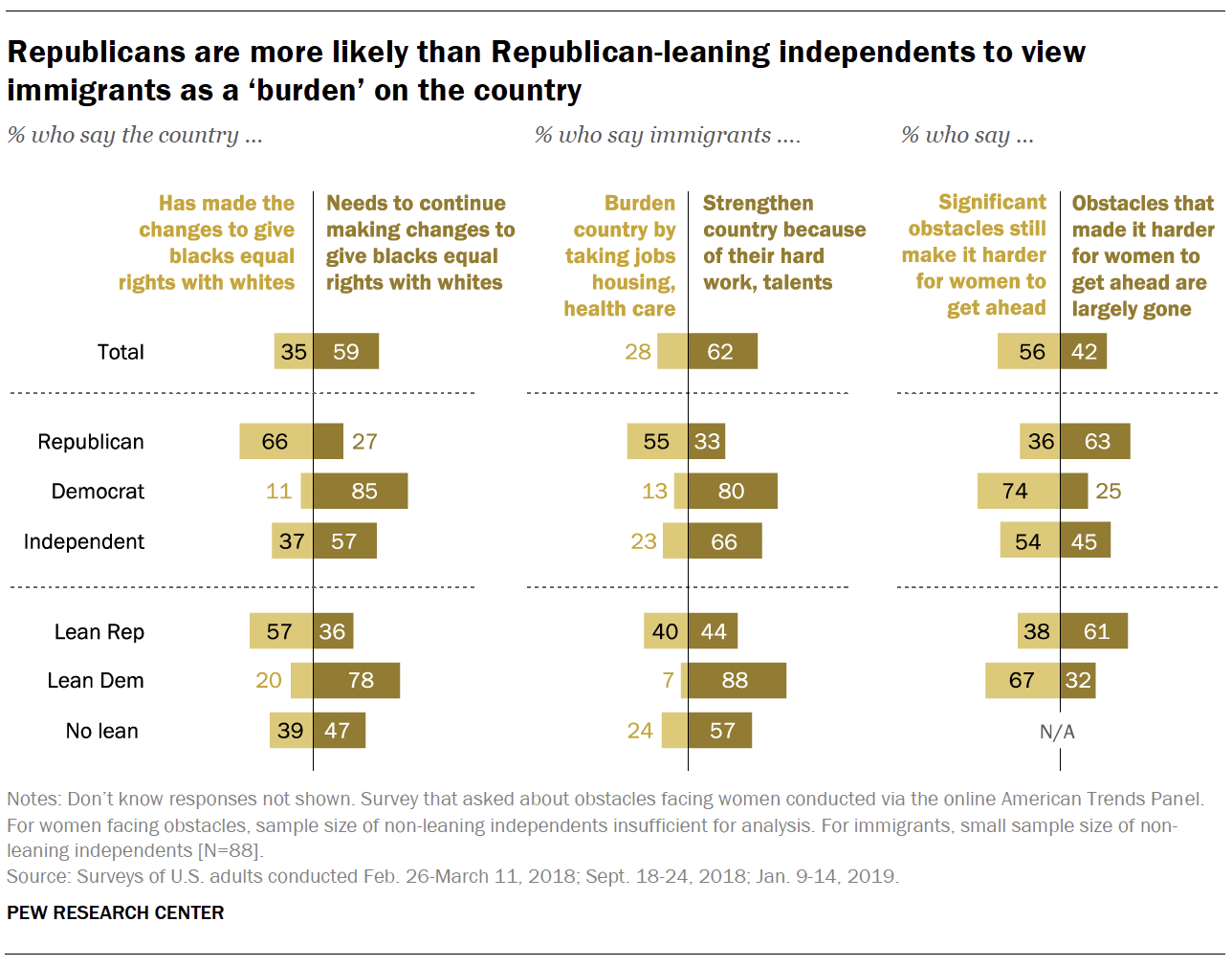
However, Republican-leaning independents differ from Republicans in their views of immigrants' impact on the country. Among GOP leaners, 44% say immigrants strengthen the country because of their hard work and talents; 40% say they are a brunt on the country because they accept jobs, housing and wellness intendance. A majority of those who place every bit Republicans (55%) say immigrants burden the country.
Views of immigrants' bear upon on the country are largely positive amidst Democratic-leaning independents (88% say they strengthen the U.South.) and those who identify as Democrats (80%).
Broad back up amid independents for aforementioned-sex spousal relationship, marijuana legalization
Public support for same-sexual activity marriage has grown rapidly over the past decade. In June 2017, a bulk of adults (62%) favored assuasive gays and lesbians to marry legally, while just 32% were opposed.
Independents' views of same-sexual practice-wedlock were like to Democrats': 73% of Democrats favored gay matrimony, every bit did 70% of independents. Among those who identified as Republicans, just twoscore% favored aforementioned-sex marriage, while 54% were opposed.
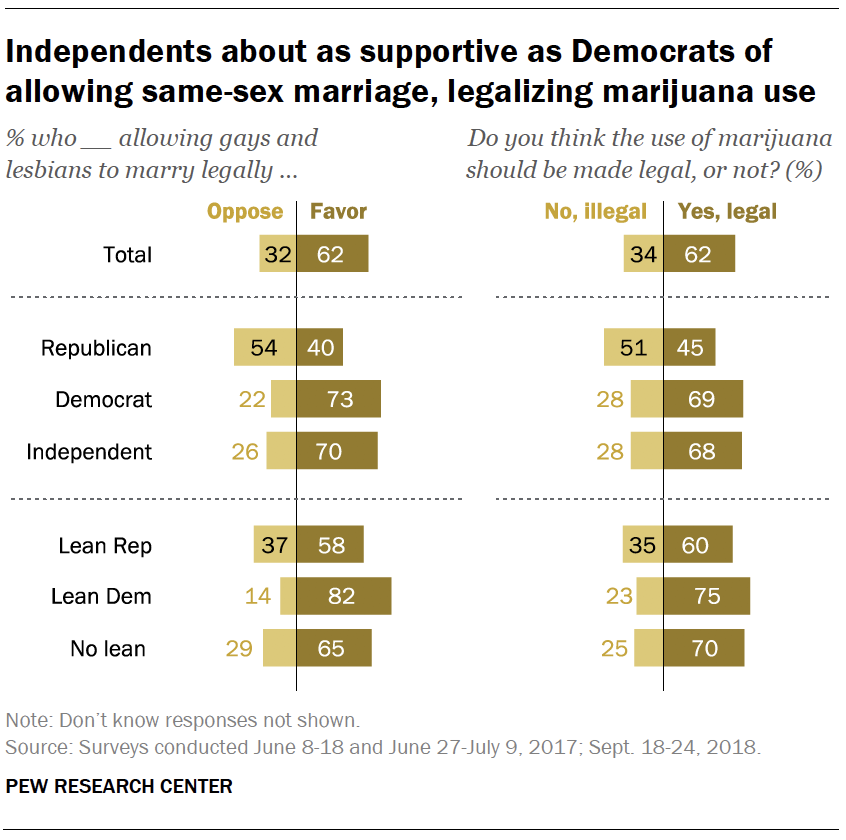 In contrast to Republicans, Republican-leaning independents favored aforementioned-sex marriage (58% were in favor, 37% were opposed). Back up for same-sex marriage was higher among Democratic-leaning independents than among Democrats (82% vs. 73%).
Public back up for legalizing marijuana use has followed a similar upward trajectory in contempo years. Currently, 62% of the public says the use of marijuana should be made legal, while 34% say it should be illegal.
Majorities of both Democrats (69%) and independents (68%) favor legalizing marijuana; Republicans are divided, with 45% supportive of legalization and 51% opposed. Among GOP-leaning independents, a 60% majority favors legalizing marijuana. And a big majority of Autonomous-leaning independents (75%) also favors marijuana legalization.
Independents who do not lean to a party widely favored same-sexual activity marriage (65% favor this), while lxx% say the use of marijuana should be legal.
More than partisans and partisan leaners embrace ideological labels
As in the past, more than independents depict their political views as moderate (43%) than conservative (29%) or liberal (24%). These shares have inverse trivial in contempo years.
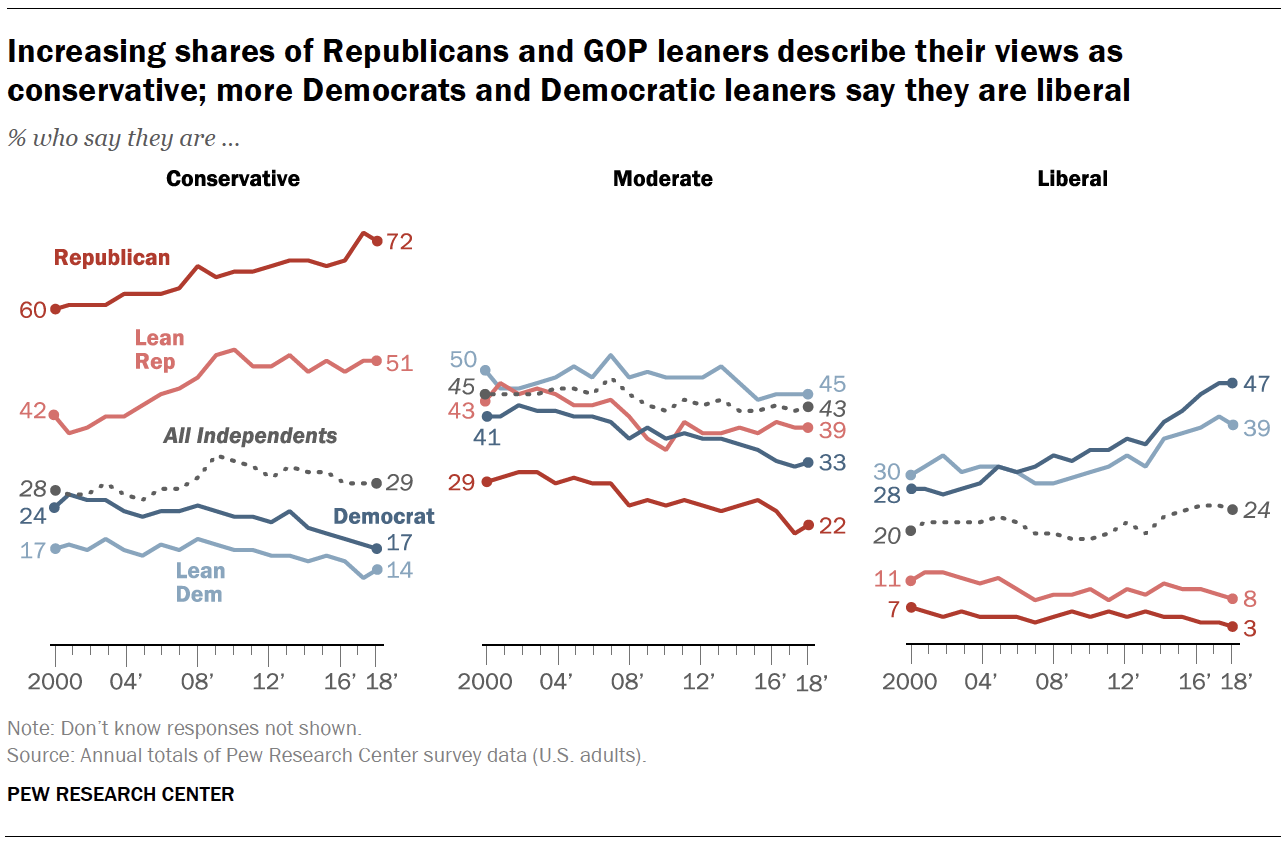
Since 2000, at that place accept been sizable increases in the shares of both Republicans and Republican-leaning independents who identify every bit conservative. Today, more Republican-leaning independents describe themselves as conservatives (51%) than as moderates (39%) or liberals (eight%). In 2000, GOP leaners included almost identical shares of conservatives (42%) and moderates (43%); 11% described their views equally liberal.
Over the aforementioned period, there has been growth in the shares of Democrats and Democratic leaners identifying as liberal. Amid Democratic-leaning independents, slightly more identify as moderates (45%) than as liberals (39%), while xiv% are conservatives. Merely the gap has narrowed since 2000, when moderates outnumbered liberals, l% to thirty%.
By contrast, moderates go along to make up the largest share of independents who do not lean to a party. About half of independents who do not lean to a political party describe their views every bit moderate, while 24% are conservatives and xviii% are liberals. These numbers have changed little since 2000.
How independents view the political parties
In a 2-party system, information technology is non surprising that most Americans view their own party favorably while viewing the opposing party unfavorably. Two-thirds of Americans (66%) view 1 political party favorably while expressing an unfavorable opinion of the other party. About one-in-five (17%) experience unfavorably toward both parties, while 12% feel favorably toward both.
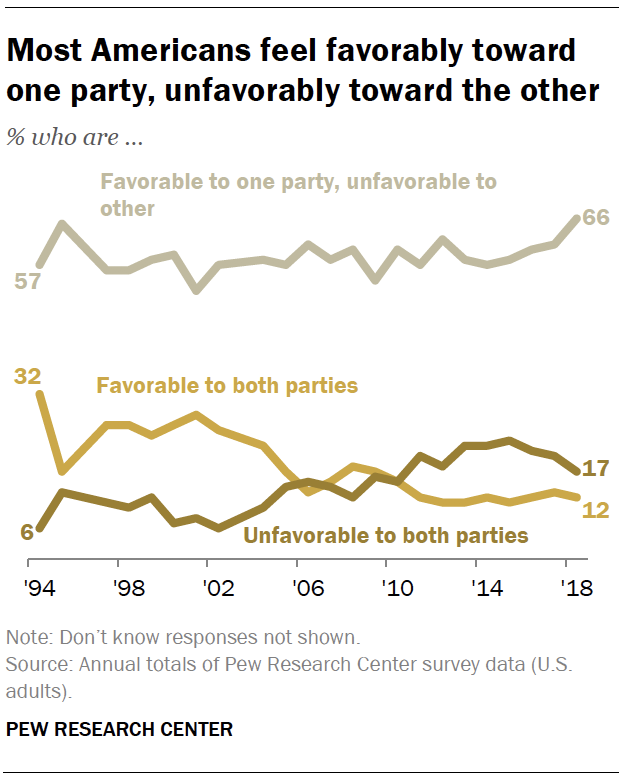 The share of Americans who take a positive view of ane political party and a negative view of the other has increased since 2015 (from 58%). Over the aforementioned period, in that location has been a decline in the share expressing a negative view of both parties, from 23% in 2015 to 17% currently.
Independents who lean toward a party are less likely than partisans to view their party favorably. In addition, far more independents (28%) than Republicans (10%) or Democrats (9%) take an unfavorable opinion of both parties.
Still, the share of independents who view both parties negatively has declined in contempo years. At i point in 2015, more than than a third of independents (36%) viewed both parties unfavorably.
Well-nigh of the change since so has come amidst Republican-leaning independents, who feel much more positively most the GOP than they did then. In July 2015, merely 44% of GOP leaners had a favorable opinion of the Republican Political party; 47% had an unfavorable view of both parties. Today, a majority of GOP leaners view the Republican Political party favorably (55%), while just 24% view both parties unfavorably.
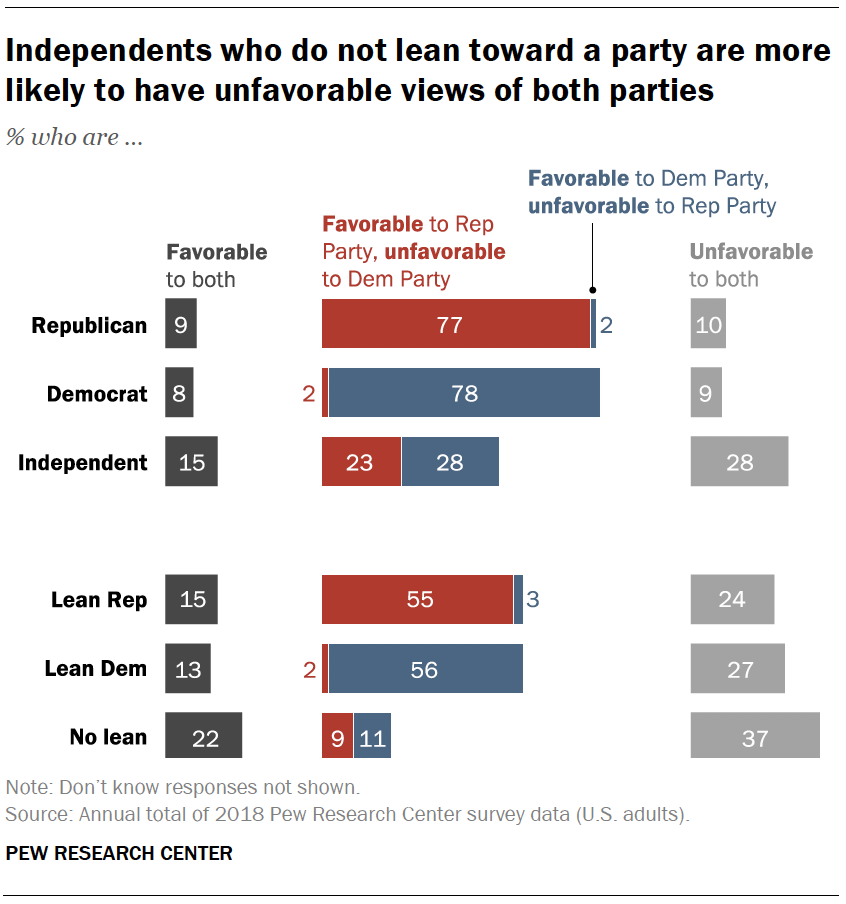 Independents who do not lean to a party are near likely to have an unfavorable opinion of both parties (37%). Another 22% have favorable opinions of both parties. Just 11% of independents who do not lean to a party view the Autonomous Party favorably, while almost equally many (9%) have a favorable view of the GOP.
Growing partisan antipathy amidst partisans and leaners
Over the past two decades, Republicans and Democrats take come up to view the opposing party more negatively. The same trend is evident amongst independents who lean toward a party.
Currently, 87% of those who place with the Republican Party view the Autonomous Party unfavorably; Republican-leaning independents are almost as likely to view the Democratic Party negatively (81% unfavorable). Opinions among Democrats and Democratic leaners are nigh the mirror epitome: 88% of Democrats and 84% of Autonomous leaners view the GOP unfavorably. In both parties, the shares of partisan identifiers and leaners with unfavorable impressions of the opposition political party are at or almost all-time highs.
Perchance more important, intense dislike of the opposing political party, which has surged over the past 2 decades among partisans, has followed a similar trajectory among independents who lean toward the Republican and Democratic parties.
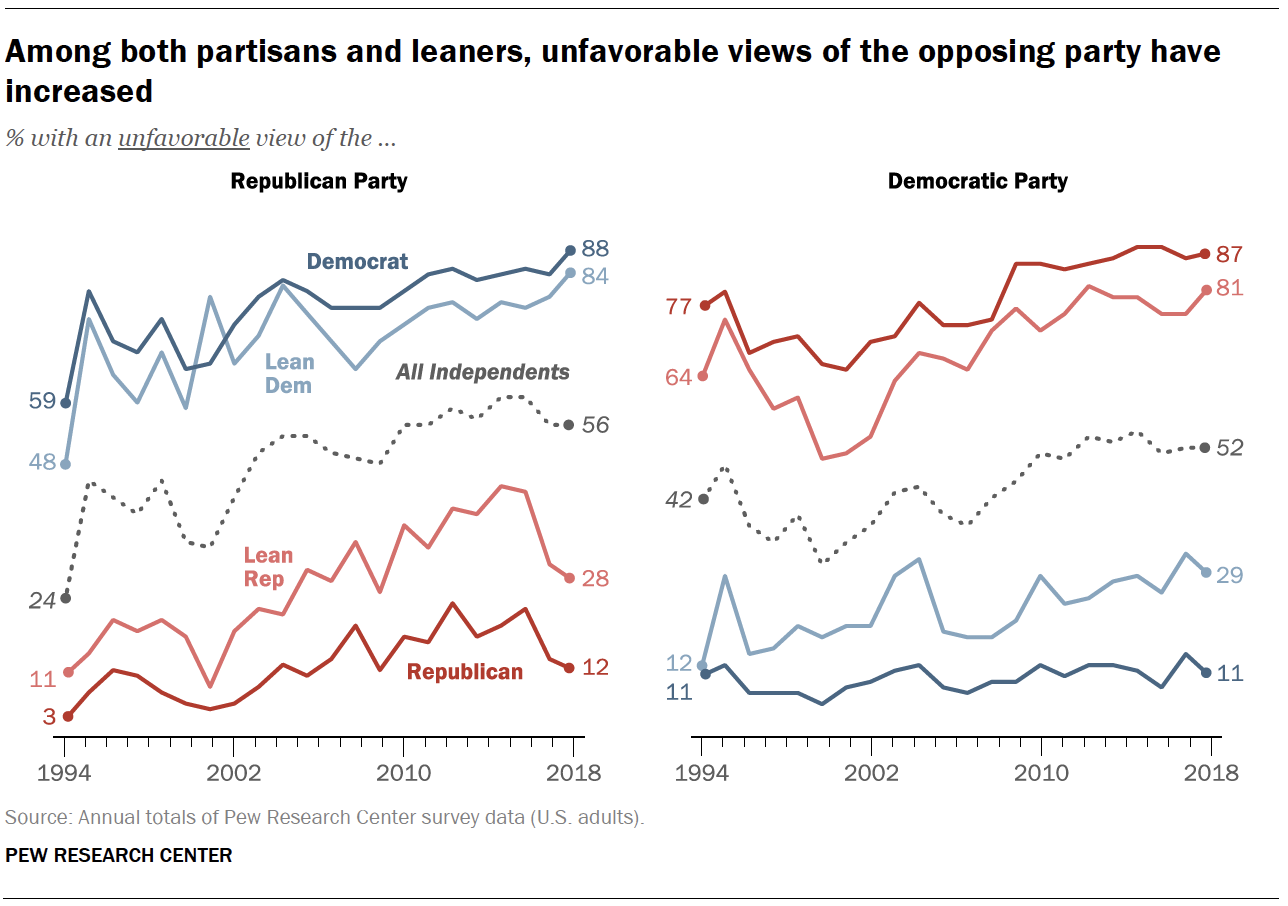
The share of Democratic-leaning independents with a very unfavorable opinion of the Republican Party has more than quadrupled between 1994 and 2018 (from viii% to 37%). In that location has been a like trend in how Republican leaners view the Autonomous Political party; very unfavorable opinions have increased from fifteen% in 1994 to 39% in 2018.

Source: https://www.pewresearch.org/politics/2019/03/14/political-independents-who-they-are-what-they-think/
Posted by: rodethermagreast.blogspot.com
0 Response to "How Many People Are Registered Independent"
Post a Comment